

Automatic Loading and Unloading for ATC CNC Router: Improve Furniture Production Efficiency
Oct 22, 2026
Leave a message
Automatic Loading and Unloading for ATC CNC Router: Improve Furniture Production Efficiency
An ATC CNC router with automatic loading and unloading provides a more efficient solution for furniture manufacturers, cabinet factories, and panel processing workshops. By combining automatic tool changing with automated material handling, this CNC router helps streamline production workflows, reduce manual intervention, and improve productivity in large-scale manufacturing.
SMARTECH provides CNC router solutions designed to meet different production requirements, helping manufacturers move toward more efficient and automated processing.
1. What Is an ATC CNC Router with Automatic Loading and Unloading?
An ATC CNC router, also known as an Automatic Tool Changer CNC Router, is equipped with an automatic tool-changing system that allows the machine to switch between different cutting tools according to programmed machining requirements.
When integrated with an automatic loading and unloading system, the machine can handle material feeding and finished workpiece removal more efficiently.
The main functions include:
Automatic loading: Feeding raw panels or workpieces into the machining area.
Automatic CNC machining: Performing cutting, drilling, milling, grooving, and other programmed operations.
Automatic tool changing: Switching between different tools without requiring manual tool replacement for every operation.
Automatic unloading: Removing finished panels from the machining area, depending on the machine configuration.
Continuous production support: Reducing operator involvement in repetitive material-handling tasks and helping maintain a more consistent workflow.
The specific automation process depends on the machine configuration, workpiece dimensions, material type, and production requirements.
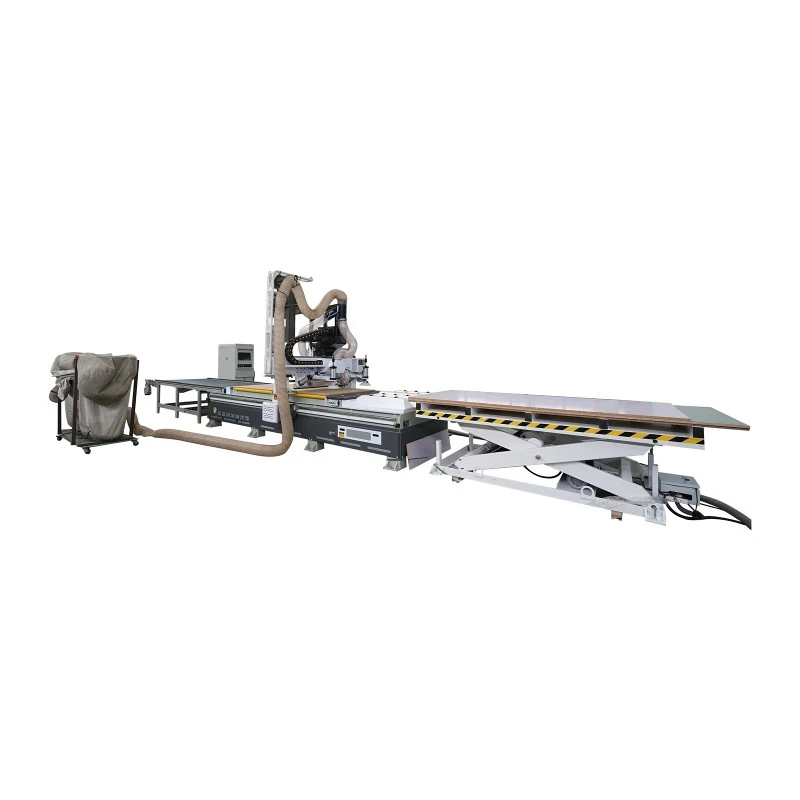
2. How Does the Automatic Loading and Unloading System Work?
An automatic loading and unloading CNC router streamlines the production process through several coordinated steps.
Step 1: Automatic Material Loading
Raw MDF boards, particle boards, plywood, or other suitable panel materials are transferred to the working table using the configured loading system.
This reduces the need for operators to manually position every panel and helps improve material-handling efficiency.
Step 2: CNC Positioning and Machining
After the material is positioned and secured, the CNC control system executes the programmed machining process.
Depending on the machine configuration and tooling, operations may include:
Panel cutting and contour machining
Cabinet door and furniture component processing
Drilling and hole processing
Grooving and slotting
Milling and engraving
Multiple machining operations on the same workpiece
Step 3: Automatic Tool Changing
When different machining operations require different tools, the ATC system automatically changes the tools according to the programmed sequence.
This reduces manual tool changes and helps minimize downtime between machining operations.
Step 4: Automatic Unloading
After machining is completed, the unloading system transfers finished workpieces away from the working area according to the configured handling method.
This helps prepare the machine for the next production cycle and reduces repetitive manual handling.
Step 5: Repeat the Production Cycle
With suitable loading, unloading, and machine-control integration, the system can support a more organized production workflow for furniture panels and other compatible workpieces.
Actual cycle times and automation levels depend on panel dimensions, machining complexity, tool changes, and the selected loading and unloading configuration.
3. Key Advantages of Automatic Loading and Unloading
Higher Production Efficiency
Manual loading and unloading can take up a considerable amount of time in panel furniture production. An automated material-handling system helps reduce these non-machining activities, allowing the production process to run more efficiently.
Reduced Labor Requirements
Automating repetitive material-handling tasks can reduce the amount of manual work required for each production cycle. Operators can focus more on production supervision, quality inspection, material preparation, and other essential tasks.
Better Production Consistency
Automated handling and CNC-controlled machining help standardize the production workflow. When properly configured and maintained, the system can support more consistent positioning and repeatable machining results.
Improved Integration with ATC Machining
The automatic tool changer allows multiple machining operations to be completed within one programmed workflow. Combined with automatic loading and unloading, it helps reduce interruptions caused by manual handling and tool replacement.
Support for Large-Batch Production
For factories processing multiple furniture panels every day, automated material handling can help improve production organization and throughput. It is particularly useful for manufacturers seeking to increase output without proportionally increasing manual handling work.
4. Applications in Furniture and Panel Processing
An automatic loading and unloading ATC CNC router is suitable for a variety of woodworking and furniture manufacturing applications, subject to machine configuration.
Cabinet and Wardrobe Manufacturing
The machine can process cabinet and wardrobe panels through cutting, drilling, grooving, and milling operations. Automated material handling helps simplify repetitive panel production.
Custom Furniture Production
Furniture manufacturers producing customized panels and components can use CNC programming to process different designs and dimensions. The ATC system helps accommodate machining tasks that require multiple tools.
MDF and Plywood Processing
The machine can be configured for machining MDF, plywood, particle board, and other compatible sheet materials used in furniture manufacturing.
Panel Furniture Factories
For factories producing furniture components in batches, automatic loading and unloading can reduce repetitive handling tasks and support a more streamlined production line.
Furniture Door and Component Processing
Depending on the tooling and CNC program, the machine can process furniture doors, decorative panels, and other compatible wooden components.
5. Automatic Loading and Unloading vs. Manual Operation
| Feature | Manual Loading and Unloading | Automatic Loading and Unloading |
|---|---|---|
| Material handling | Requires more operator involvement | Automates configured handling steps |
| Production workflow | More dependent on manual coordination | More streamlined and consistent |
| Labor requirements | Higher for repetitive handling tasks | Potentially lower for material handling |
| Batch production | Depends heavily on operator efficiency | Better suited to repetitive production workflows |
| ATC machining | Automatic tool changes are possible | Automatic tool changes can be combined with automated handling |
| Initial investment | Generally lower | Generally higher due to automation equipment |
The best choice depends on production volume, labor costs, workshop layout, panel specifications, and investment budget. For smaller workshops, a standard ATC CNC router may be sufficient. For larger factories, automatic loading and unloading can offer greater value when the system is properly matched to production requirements.
6. What Should You Consider Before Choosing an Automatic ATC CNC Router?
Before purchasing an automatic loading and unloading CNC router, manufacturers should evaluate several important factors.
Panel size and thickness: Confirm that the machine and handling system can accommodate the dimensions and weight of your materials.
Machining requirements: Identify whether your production requires cutting, drilling, grooving, milling, engraving, or a combination of operations.
Tool-changing capacity: Select a suitable ATC configuration based on the number and types of tools required for your products.
Automation level: Determine whether you need automatic loading only, automatic unloading only, or an integrated loading and unloading solution.
Production capacity: Evaluate expected daily output, machining time, material changeover time, and the number of shifts.
Workshop layout: Make sure there is sufficient space for material storage, loading and unloading equipment, finished panels, and safe operator access.
After-sales support: Consider installation guidance, operator training, technical support, and spare-parts availability when selecting a CNC router supplier.
7. Why Choose SMARTECH ATC CNC Router Solutions?
SMARTECH specializes in CNC machinery for industrial manufacturing and woodworking applications. We help customers identify suitable CNC router configurations based on their machining processes, materials, production targets, and automation requirements.
Our CNC router solutions can be configured for different applications, including cabinet manufacturing, wardrobe production, panel furniture processing, and other woodworking operations.
When selecting a machine, customers can discuss the following requirements with our team:
Required working area and panel dimensions
Automatic tool-changing requirements
Loading and unloading configuration
Spindle power and machining applications
CNC control system and optional equipment
Installation guidance and technical support
Our goal is to help furniture manufacturers select practical CNC machining solutions that improve workflow efficiency and support long-term production development.
Conclusion
An automatic loading and unloading ATC CNC router combines automated material handling with efficient multi-tool CNC machining. For cabinet factories, wardrobe manufacturers, and panel furniture producers, it can reduce repetitive manual work, streamline production processes, and support higher manufacturing efficiency.
Choosing the right configuration is essential to achieving the expected productivity benefits. By evaluating your materials, machining processes, production volume, and workshop layout, you can determine whether an integrated automatic loading and unloading system is the right investment for your business.
Contact SMARTECH today to discuss your furniture production requirements and find a suitable ATC CNC router solution for your factory.
Frequently Asked Questions
1. What is the main advantage of an ATC CNC router with automatic loading and unloading?
Its main advantage is the combination of automatic tool changing and automated material handling, which can reduce repetitive manual operations and improve production workflow efficiency.
2. What materials can an automatic loading and unloading CNC router process?
Depending on the machine configuration and tooling, it can process materials such as MDF, plywood, particle board, and other suitable woodworking panels.
3. Can an automatic ATC CNC router be used for cabinet and wardrobe production?
Yes. It can be configured for cabinet panels, wardrobe components, furniture doors, and other compatible panel-processing applications.
4. Does automatic loading and unloading mean the machine operates completely without an operator?
Not necessarily. The automation level depends on the configuration. Material preparation, production supervision, quality inspection, and other tasks may still require operator involvement.
5. Is an automatic loading and unloading system suitable for small furniture factories?
It depends on production volume, labor costs, available space, and budget. Smaller factories may benefit from a standard ATC CNC router, while larger production facilities may gain more value from an integrated automated handling system.